Letrial: Commanding Industrial Extended Sans Serif
When a project demands more than just letters on a screen—when it requires an anchor, a foundation of pure visual force—you turn to typefaces engineered for that purpose. Letrial is precisely that: a commanding industrial extended sans-serif font built to dominate layouts and establish immediate authority. This isn't a decorative script or a delicate serif font; it's a structural element, designed for high-impact scenarios where stability and presence are non-negotiable.
Anatomy of an Industrial Powerhouse
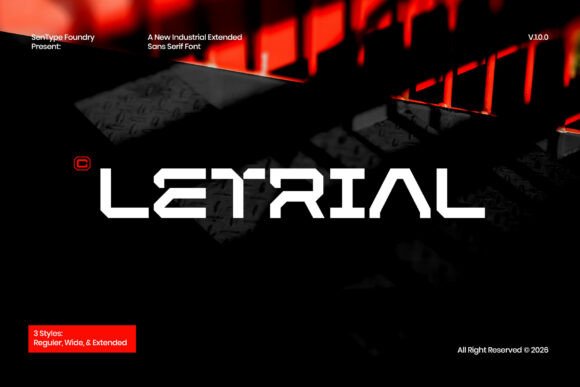
At its core, Letrial’s visual personality is defined by its extended width and robust construction. The letterforms are deliberately wide, creating a sense of grounded stability and taking up valuable visual real estate. This extended nature allows text blocks to hold their own against bold imagery or complex design grids without appearing fragile. The terminals are clean and geometric, reflecting a no-nonsense, engineered aesthetic. There’s a subtle uniformity in stroke width that avoids the distraction of high contrast, focusing instead on pure, unadulterated form.
The font ships with three distinct styles—Regular, Wide, and Extended—each offering a different degree of horizontal expansion. The Regular style provides a solid, versatile base. The Wide style pushes the boundaries, creating even more imposing headlines. The Extended style is the most dramatic, perfect for moments where you need text to function almost as a graphic block itself. This trio gives designers supreme flexibility to manage hierarchy and spatial relationships within a single typographic family, ensuring consistency while allowing for dynamic variation.
Where Letrial Truly Excels
Understanding a font's ideal environment is key to using it effectively. Letrial’s industrial DNA makes it a natural fit for specific creative territories. In the realm of digital design, it’s a standout for futuristic sci-fi or cyberpunk video game UI headlines, where its geometric precision and commanding width evoke advanced technology and gritty interfaces. Think menu screens, in-game HUD elements, or title cards that need to feel like part of a machine.
For branding and identity, this typeface excels in sectors that project strength, innovation, and technical prowess. Brutalist streetwear clothing brands can leverage its raw, structural appeal for logos and apparel graphics. High-octane automotive tech companies or engineering firms will find its stability perfectly aligns with themes of precision and power. Progressive athletic merchandise, from performance gear to team branding, benefits from its active, forward-moving energy. Even electronic music festival promotional banners can harness Letrial’s bold presence to cut through visual noise and signal a powerful, immersive experience.
In editorial and publishing, consider Letrial for magazine feature headers, especially in design, technology, or automotive publications. Its strength lies in display use; it’s a premium font for headlines, pull quotes, and cover lines, not for body text. When used in packaging design, it can instantly communicate a product’s modern, technical, or premium nature—think tech accessories, specialty tools, or contemporary beverage branding.
Practical Guidance for Implementation
Choosing a creative font like Letrial is just the first step. Implementing it effectively requires a thoughtful approach. Start by evaluating the project's core message. Does your brand or project aim to feel innovative, strong, structured, or futuristic? If the answer is yes, Letrial is a strong candidate. If the goal is warmth, tradition, or personal touch, a handwritten font or classic serif font would be more appropriate.
Font pairing is crucial. Letrial’s assertive nature demands a complementary partner that provides contrast and readability for longer text. A clean, neutral sans-serif font for body copy often works beautifully, allowing Letrial to own the headlines. For a different mood, a highly legible serif font can create an interesting dialogue between industrial strength and traditional elegance. Always test pairings in context—mock up a social media graphic, a webpage header, or a product label to see how the fonts interact visually.
Pay close attention to the included styles. Use the Regular style for subheadlines or shorter text blocks where you want presence without overwhelming. The Wide and Extended styles are your tools for major headlines and logos where maximum impact is required. Be mindful of readability; at very small sizes, the extended forms might lose some legibility, so always test at the intended scale. For commercial projects, ensure you have the correct license. Most premium font licenses cover a wide range of uses, from web design to merchandise, but it’s your responsibility to verify the terms match your project's scope.
Ultimately, Letrial is more than just a set of glyphs. It’s a design asset, a tool for building a specific kind of brand identity and visual hierarchy. Used with intention, it doesn’t just display text—it makes a statement, anchoring your entire design in a framework of modern, industrial authority. Its value lies in its ability to instantly communicate a complex set of attributes: power, precision, and a forward-thinking mindset. For the right project, that’s an invaluable foundation to build upon.